
Homelessness Among Domestic Violence Survivors Jumps 43% as Shelters Face Funding Freeze

By Rachael Gaudiosi
Published August 4, 2026
LOS ANGELES — A federal judge blocked the Trump administration Thursday from cutting off Los Angeles’ federal homelessness funding — but his ruling delivered a blistering assessment of the agencies responsible for overseeing the system.
U.S. District Judge David Carter accused LAHSA, the City of Los Angeles and HUD of participating in a decades-long cycle of failure and blame-shifting in which responsibility was routinely deflected, while nearly $1 billion in federal taxpayer dollars flowed through the Los Angeles Continuum of Care over the past five years.
“For decades, LAHSA and HUD have been in a joint partnership in failure,” Carter wrote.
The ruling temporarily blocks HUD’s June 11 decision and allows the Los Angeles Homeless Services Authority to access federal homelessness funding for fiscal year 2026.
Nearly $241 million already earmarked by Congress for the Los Angeles region is at stake. Carter found an abrupt cutoff could threaten housing and services for more than 11,000 people.
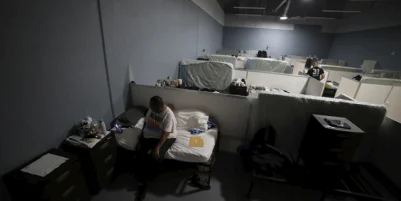
The broader funding crisis is already affecting Jewish Family Service LA’s Hope Transitional Shelter, which serves women and children who fled domestic violence.
The shelter has been operating without government funding for the past four and a half months, according to JFSLA CEO Eli Veitzer. Its $300,000 annual LAHSA contract expired April 1 and covered half of the shelter’s operating budget.
JFSLA has since tapped emergency contingency funds to continue providing free shelter, mental health counseling, case management, and parenting support to 12 women and 25 children who rely on the shelter.
“We are relieved and encouraged to see Judge Carter affirm the importance of this funding for the Angelenos in need that we serve. However, given the ongoing court battle, it does not guarantee quick resolution to the funding crisis affecting the 12 women and 25 children who fled domestic violence and now rely on Jewish Family Service LA’s Hope Transitional Shelter for their safety and survival,” Veitzer said.
He warned the organization cannot rely indefinitely on emergency reserves.
“Our annual $300,000 LAHSA contract, which expired April 1, covers half of the shelter’s operating budget. JFSLA has tapped its emergency contingency funds to keep services running, but that isn’t sustainable. This ruling is certainly a huge step in the right direction, but until the funding resumes, our ability to continue serving survivors of domestic violence in the future remains in question, and our shelter residents remain at risk,” Veitzer said.
Carter’s ruling, however, was far from a vote of confidence in the homelessness system receiving the federal money.
Instead, the judge described a bureaucracy where agencies have repeatedly pointed fingers at one another when questions arise over data and compliance.
“When data inconsistencies or compliance issues arise, the City points to LAHSA. In turn, LAHSA attributes its problems to a lack of information or cooperation from the City,” Carter wrote.
The relationship “has fostered a system in which responsibility is routinely deflected, allowing both entities to evade accountability, with no single party willing to take responsibility,” Carter wrote.
HUD did not escape the criticism.
“HUD has also been complicit in this blame-shifting cycle,” Carter wrote, adding that the agencies involved “have effectively abdicated governance.”
The unusually sharp rebuke comes after HUD moved June 11 to strip LAHSA of its authority to apply for federal funding on behalf of the Los Angeles Continuum of Care, which coordinates housing and services to prevent and end homelessness across Los Angeles County.
HUD Secretary Scott Turner accused LAHSA of making false statements and pointed to failures involving financial management and safeguards against conflicts of interest.
Carter said HUD had long known about the same problems it is now citing to justify its action against LAHSA.
The Los Angeles Continuum of Care has received nearly $1 billion in federal taxpayer dollars over the past five years.
LAHSA officials have said HUD relied on previous financial reviews despite corrective measures already underway, including efforts to modernize financial systems and strengthen internal controls.
The stakes of suddenly stopping the funding, Carter found, extend well beyond the agencies fighting over who is responsible.
Federal dollars support 140 projects serving 89 veterans, 1,030 families, 1,923 children, 823 transition-age youth, 1,627 seniors and 901 people impacted by intimate partner violence.
“This has great consequences for the Los Angeles region and impacts the region’s ability to compete with other cities across the country for limited homelessness funding nationwide,” Carter wrote.
Los Angeles County Supervisor Kathryn Barger said the ruling recognizes the need to keep people housed without abandoning efforts to overhaul the system.
“Judge Carter’s ruling is fair, measured, and recognizes two realities that must be addressed simultaneously,” Barger said. “First, we cannot abruptly disrupt funding that people currently experiencing homelessness depend on to remain housed and connected to critical services. Second, meaningful reform of our region’s homeless services system cannot be delayed.”
Veitzer said Thursday’s ruling represents progress but does not resolve the immediate uncertainty facing JFSLA and the shelter.
“We’re grateful to LAHSA, the city, county, and our partners for their advocacy, and we’re actively pursuing alternative long-term funding. Survivors and their children should never be collateral damage in a funding dispute. We will keep calling on all levels of government to protect the resources vulnerable Angelenos depend on to live free from violence, with safety and dignity,” he said.
The ruling lands as officials point to recent data showing progress in reducing unsheltered homelessness.
HUD data cited by Gov. Gavin Newsom in June showed a 10.3% decline in unsheltered homelessness in Los Angeles, the largest regional drop nationwide.
Carter’s ruling preserves access to federal funding for now while leaving Los Angeles with a damning assessment of the system behind it — one in which the judge said responsibility between the City and LAHSA has been “routinely deflected,” while HUD has also been “complicit” in the cycle.
Editor’s Note: This story includes reporting from City News Service, a content partner of Westside Current.

